Barriers of the McKean-Vlasov energy via a mountain pass theorem in the space of probability measures
J. Funct. Anal. 279(11), 108720 (2020)
Abstract
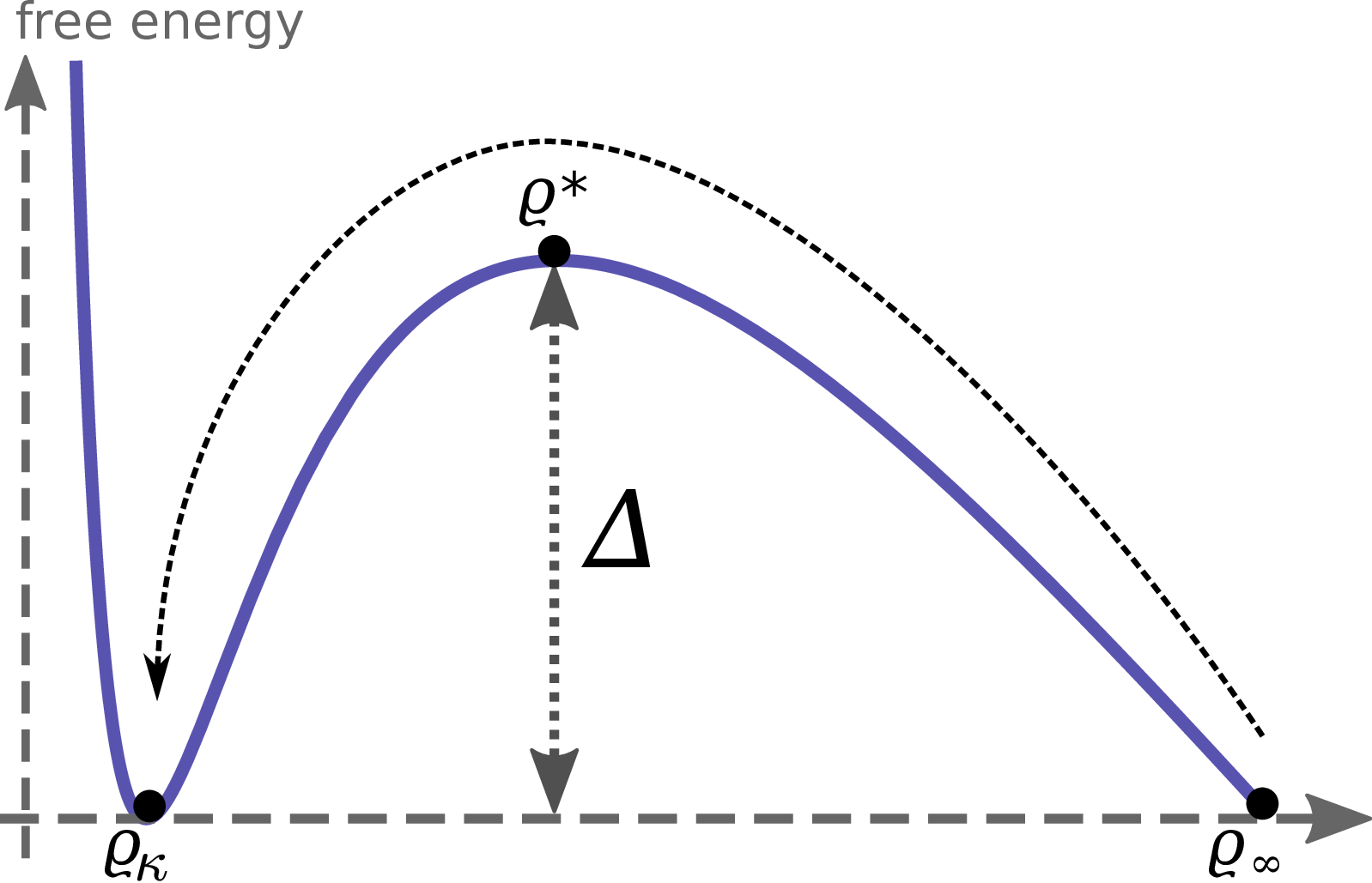
We show that the empirical process associated with a system of weakly interacting diffusion processes exhibits a form of noise-induced metastability. The result is based on an analysis of the associated McKean–Vlasov free energy, which, for suitable attractive interaction potentials, has at least two distinct global minimisers at the critical parameter value . On the torus, one of these states is the spatially homogeneous constant state, and the other is a clustered state. We show that a third critical point exists at this value. As a result, we obtain that the probability of transition of the empirical process from the constant state scales like , with the energy gap at . The proof is based on a version of the mountain pass theorem for lower semicontinuous and -geodesically convex functionals on the space of probability measures equipped with the -Wasserstein metric, where is a complete, connected, and smooth Riemannian manifold.
Publication history
- Preprint
- 2019-05-28
- Received
- 2019-05-28
- Accepted
- 2020-07-20
- Published online
- 2020-08-06
- Published
- 2020-12
Indexed in: MathSciNet · zbMATH
Topics: McKean-Vlasov, phase transitions, metastability