Poincaré and logarithmic Sobolev inequalities by decomposition of the energy landscape
Ann. Probab. 42(5), 1809–1884 (2014)
Abstract
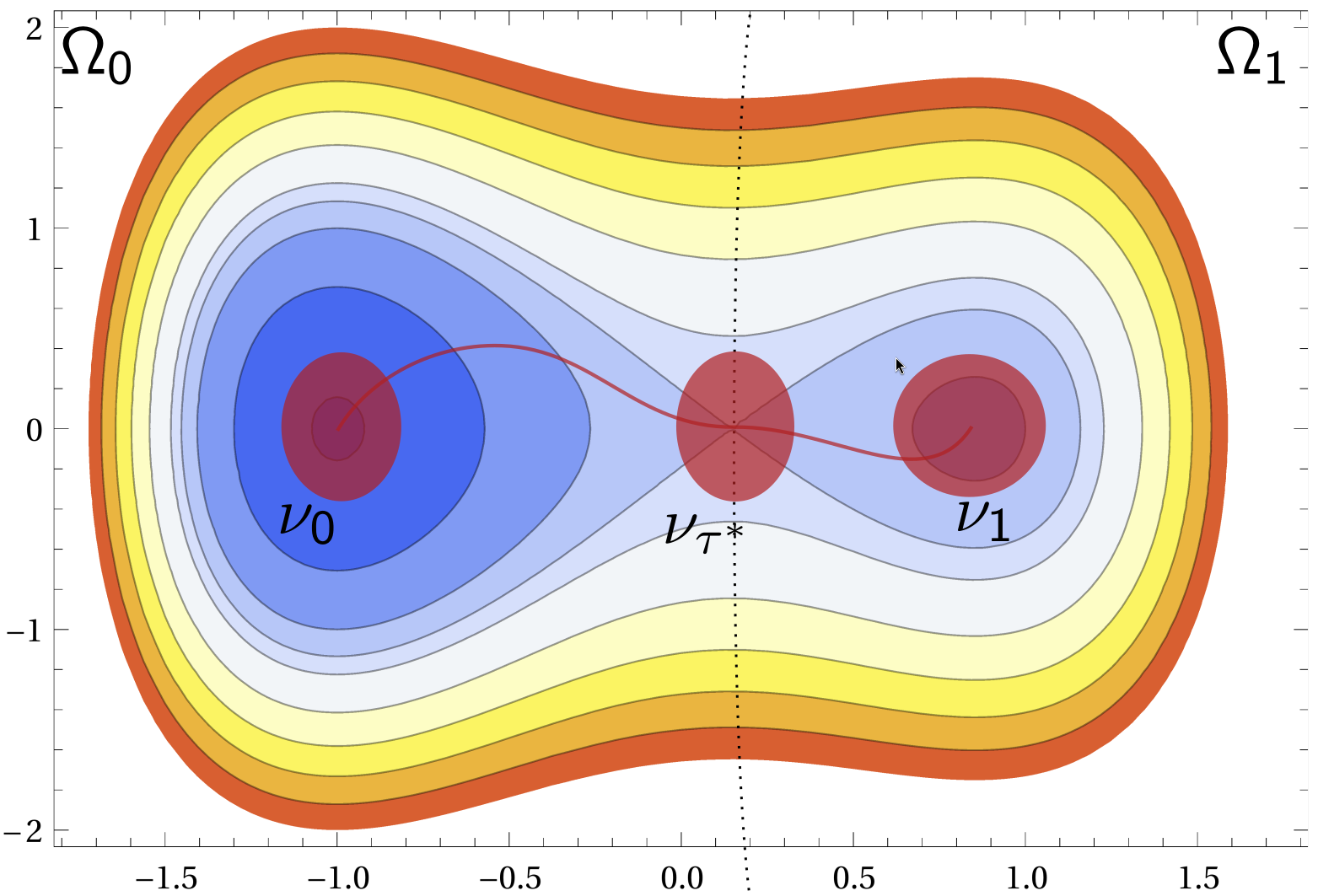
We consider a diffusion on a potential landscape which is given by a smooth Hamiltonian in the regime of low temperature . We proof the Eyring-Kramers formula for the optimal constant in the Poincaré (PI) and logarithmic Sobolev inequality (LSI) for the associated generator of the diffusion. The proof is based on a refinement of the two-scale approach introduced by Grunewald et al. [Ann. Inst. Henri Poincaré Probab. Stat. 45 (2009) 302-351] and of the mean-difference estimate introduced by Chafaï and Malrieu [Ann. Inst. Henri Poincaré Probab. Stat. 46 (2010) 72-96]. The Eyring-Kramers formula follows as a simple corollary from two main ingredients: The first one shows that the PI and LSI constant of the diffusion restricted to metastable regions corresponding to the local minima scales well in . This mimics the fast convergence of the diffusion to metastable states. The second ingredient is the estimation of a mean-difference by a weighted transport distance. It contains the main contribution to the PI and LSI constant, resulting from exponentially long waiting times of jumps between metastable states of the diffusion.
Publication history
- Preprint
- 2012-02-07
- Published
- 2014-09
Indexed in: MathSciNet · zbMATH · Google Scholar
Topics: metastability, functional inequalities, entropy methods