Institute of Applied Analysis
University Ulm
Helmholtzstraße 18
89081 Ulm
Room E.10
Tel.: +49 731 50-23560
andre.schlichting@uni-ulm.de

News and Updates
- Preprint: Maximal monotonicity and contraction semigroup for the quantum drift-diffusion (Derrida-Lebowitz-Speer-Spohn) equationTogether with Daniel Matthes and Giuseppe Savaré, we study the quantum drift-diffusion, or Derrida–Lebowitz–Speer–Spohn (DLSS), equation for a nonnegative density on a bounded convex domain with Neumann boundary conditions, in the square-root variable . We show that the DLSS operator, defined and monotone on smooth strictly positive functions, admits a unique maximal monotone extension in , explicitly given by the minimal (defect-free) operator plus the normal cone of the positivity constraint. The generated semigroup, which contracts the Hellinger distance between the densities, thus yields a canonical solution — existing, unique, and stable for every nonnegative initial datum and in every space dimension — independent of any approximation scheme: it is in fact the unique contraction semigroup extending the classical evolutions that emanate from smooth, uniformly positive data. The implicit Euler scheme converges to it, and along the flow. When the datum belongs to the domain of the operator, the solution is strong and satisfies the equation pointwise, with no reaction term created on the vacuum . We characterize the trajectories in several equivalent ways — as Bénilan integral solutions and through one-sided weak formulations — prove the maximality of the operator also in the – duality and, in dimension , identify the flow with the weak solutions in the uniqueness class of Fischer. A second-order estimate of independent interest underlies the construction: on a convex domain with Neumann conditions the dissipation is finite exactly when , and it then controls the full Hessian of , in every dimension.
arXiv:2608.16792v1 - Preprint: Formation of clusters and coarsening in weakly interacting diffusions
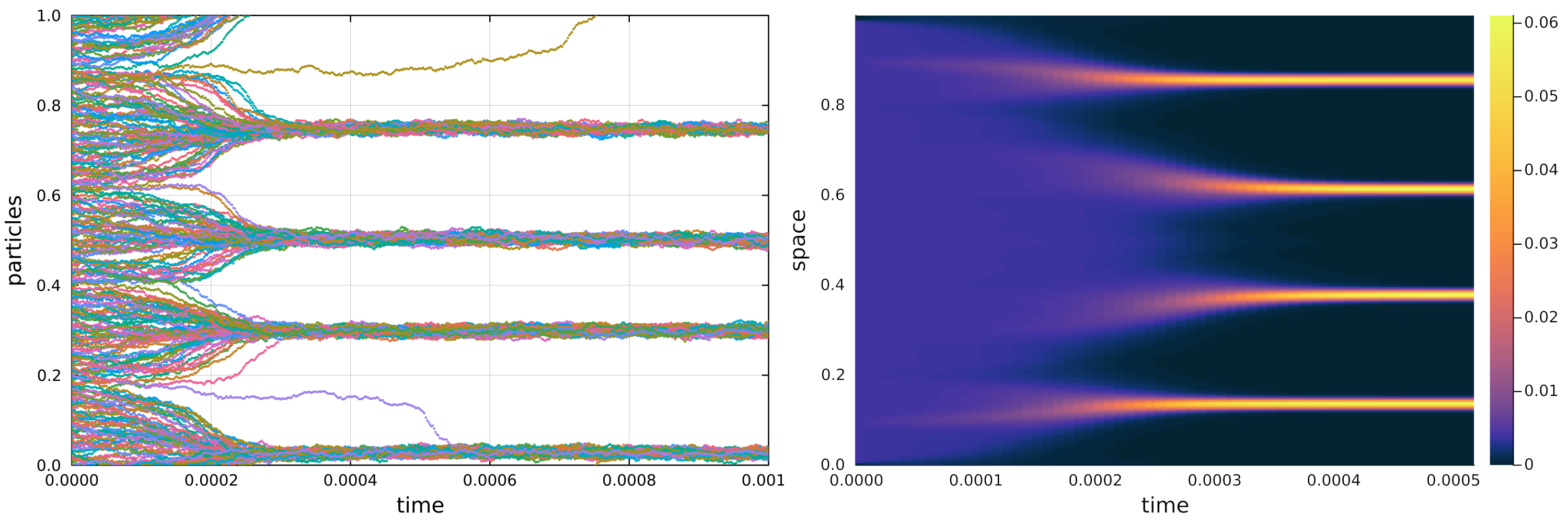
Together with Nicolai Gerber, Rishabh Gvalani, Martin Hairer and Greg Pavliotis, we study the clustering behavior of weakly interacting diffusions under the influence of sufficiently localized attractive interaction potentials on the one-dimensional torus. We describe how this clustering behavior is closely related to the presence of discontinuous phase transitions in the mean-field PDE. For local attractive interactions, we employ a new variant of the strict Riesz rearrangement inequality to prove that all global minimizers of the free energy are either uniform or single-cluster states, in the sense that they are symmetrically decreasing.
We analyze different timescales for the particle system and the mean-field (McKean-Vlasov) PDE, arguing that while the particle system can exhibit coarsening by both coalescence and diffusive mass exchange between clusters, the clusters in the mean-field PDE are unable to move and coarsening occurs via the mass exchange of clusters. By introducing a new model for this mass exchange, we argue that the PDE exhibits dynamical metastability. We conclude by presenting careful numerical experiments that demonstrate the validity of our model. arXiv:2510.17629

- Preprint: Derivation of the fourth-order DLSS equation with nonlinear mobility via chemical reactions
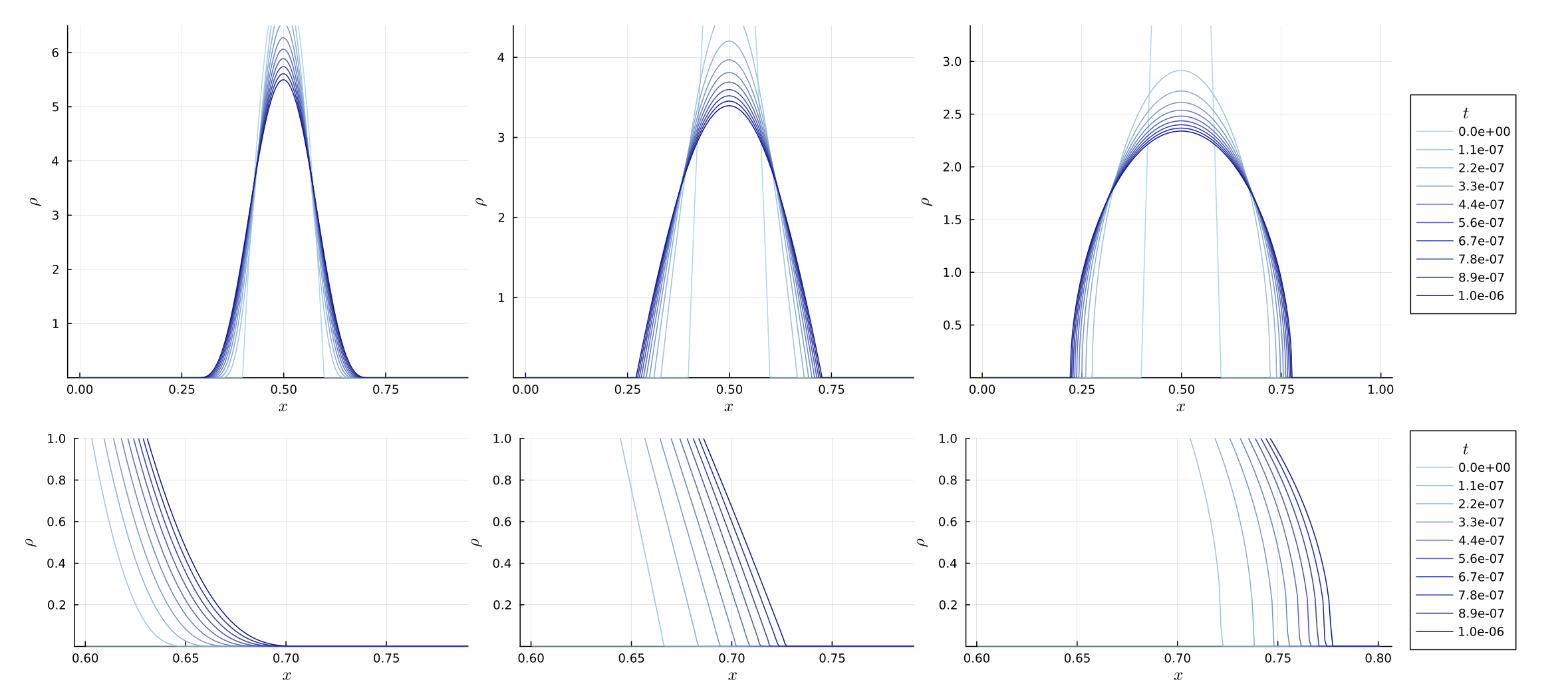
Together with Alexander Mielke and Artur Stephan, we provide a derivation of the fourth-order DLSS equation based on an interpretation as a chemical reaction network. We consider the rate equation on the discretized circle for a process in which pairs of particles occupying the same site simultaneously jump to the two neighboring sites; the reverse process involves pairs of particles at adjacent sites simultaneously jumping back to the site located between them. Depending on the rates, in the vanishing-mesh-size limit we obtain either the classical DLSS equation or a variant with nonlinear mobility of power type. Via EDP convergence, we identify the limiting gradient structure to be driven by entropy with respect to a generalization of diffusive transport with nonlinear mobility. Interestingly, the DLSS equation with power-type mobility shares qualitative similarities with the fast diffusion and porous medium equation, since we find traveling wave solutions with algebraic tails or compactly supported polynomials, respectively.
For details see arXiv:2510.07149
- Preprint: Existence and Non-existence for Continuous Generalized Exchange-Driven Growth model
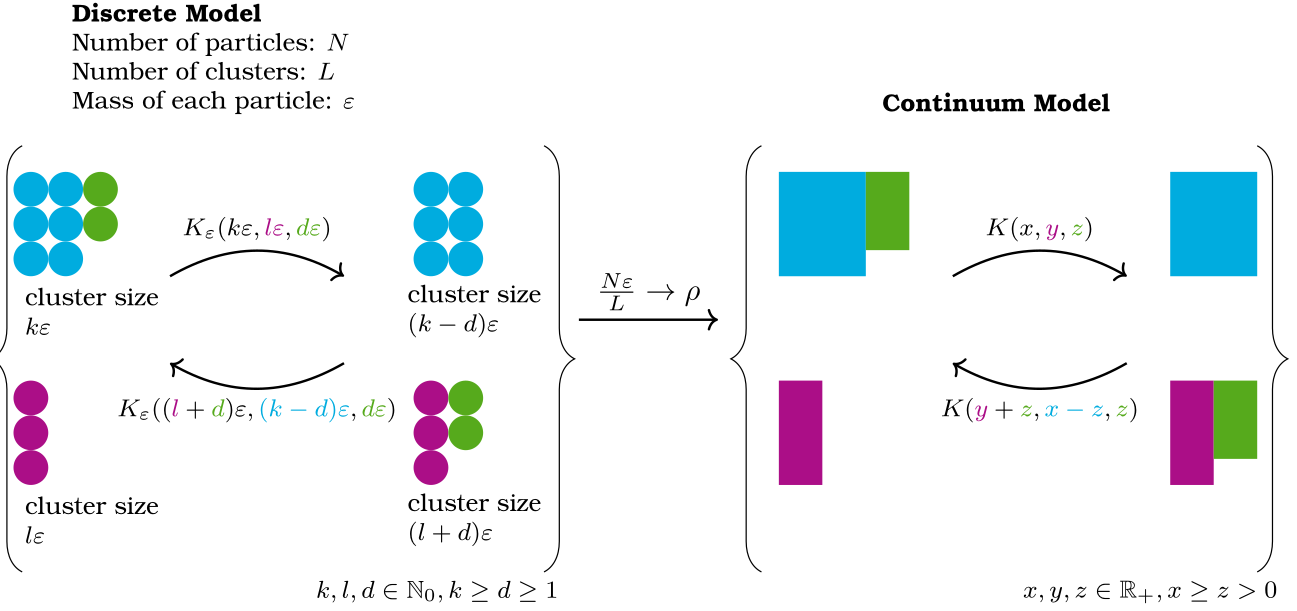
Together with Chun Yin “Solomon Lam, after the derivation of the continuous generalized exchange-driven growth model in arXiv:2503.21572, we continue the study of the existence and uniqueness of solutions for kernels with superlinear growth at infinity and singularity at the origin. Moreover, we show the non-existence of solutions for kernels with sufficiently rapid growth. The latter result is shown via the finite-time gelation and instantaneous gelation in the sense of moment blow-up. For details see arXiv:2509.05262.
- Extended updated preprint: Variational convergence for an irreversible exchange-driven stochastic particle system
Together with Jasper Hoeksema and Chin Yin Lam, we considerably extended and updated the previous version of the arXiv preprint 2401.06696.
We show the variational convergence of an irreversible Markov jump process describing a finite stochastic particle system to the solution of a countable infinite system of deterministic time-inhomogeneous quadratic differential equations known as the exchange-driven growth model, which has two conserved quantities. As a bounded perturbation of the reversible kernel, the variational formulation is a generalization of the gradient flow formulation of the reversible process and can be interpreted as the large deviation functional of the Markov jump process. As a consequence of the variational convergence result, we show the propagation of chaos of the Markov processes to the limiting equation and the -convergence of the energy functional. The latter convergence is consistent with related results for reversible coagulation-fragmentation equations and reveals the connection of stochastic processes to the long-time condensation phenomena in the limit equation.